御林招新题:Agent 专题

学习搭建 Agent

实现工具调用(Tool Calling)

  • 设计工具:你必须实现至少两个工具。当用户提出相关需求时,你的 Agent 必须能够识别并调用相应的工具。

    qwen 的工具调用整合了 OpenAI,所以可以看 OpenAI 的使用文档:函数调用 - OpenAI 中文文档,写得比较简略;openai-python/api.md at main · openai/openai-python 仓库,详细但是冗杂

    基本步骤:

    1. 创建助手,以调用外部 API 来回答问题(定义函数)
    2. 将自然语言转换为 API 调用
    3. 从文本中提取结构化的数据
    • 工具1:天气查询工具

      可以使用爬虫实现,也可以寻找相应的api提供商

      • 功能:接受城市名作为参数。
      • 返回:指定城市的实时天气信息,包括温度、天气状况(晴、多云、雨等)和湿度。
      • 用户交互示例:当用户问“北京今天天气怎么样?”时,Agent 必须识别出“北京”并调用此工具,然后返回天气信息。

    注册接口:天气预报查询接口_天聚地合

     1
     2
     3
     4
     5
     6
     7
     8
     9
    10
    11
    
    WEATHER_API_KEY = "..."
    def get_weather(city: str) -> str:
        url = f"http://apis.juhe.cn/simpleWeather/query?city={city}&key={WEATHER_API_KEY}"
        response = requests.get(url)
        data = response.json()
        if data.get("reason") == "查询成功!":
            result = data["result"]
            return (f"{city}当前天气:{result['realtime']['info']},"
                    f"温度:{result['realtime']['temperature']}℃,"
                    f"湿度:{result['realtime']['humidity']}%")
        return f"查询天气失败:{data.get('reason', '未知错误')}"
    
    • 工具2:网络搜索工具

      可以使用Searxng,也可以使用其它专业的api

      • 功能:接受关键词作为参数。
      • 返回:基于关键词的网络搜索结果摘要。
      • 用户交互示例:当用户问“2024 年奥运会在哪里举办?”时,Agent 能够使用此工具进行搜索并给出答案。

    试了自己的 searxng,可能是格式问题跑不通,换了个 API

     1
     2
     3
     4
     5
     6
     7
     8
     9
    10
    11
    12
    13
    14
    15
    16
    17
    18
    19
    20
    21
    22
    23
    24
    25
    26
    27
    28
    29
    30
    31
    32
    33
    
    def web_search(query: str) -> str:
        # DuckDuckGo 免费搜索 API(无需注册,直接使用)
        url = "https://api.duckduckgo.com/"
        params = {
            "q": query,
            "format": "json",
            "no_html": 1,  # 不返回 HTML 内容
            "no_redirect": 1  # 不返回跳转链接
        }
        try:
            response = requests.get(url, params=params, timeout=10)
            response.raise_for_status()  # 检查 HTTP 状态码(如 404、500 会报错)
        except requests.exceptions.RequestException as e:
            return f"搜索请求失败:{str(e)}"
    
        try:
            data = response.json()
        except requests.exceptions.JSONDecodeError:
            return "搜索结果解析失败:返回内容不是有效的 JSON"
    
        # 提取结果(DuckDuckGo 的 JSON 结构与 SearXNG 不同)
        summary = []
        # 1. 优先取 "Abstract"(摘要)
        if data.get("Abstract"):
            summary.append(f"摘要:{data['Abstract']}")
        # 2. 再取 "RelatedTopics"(相关主题)的前 2 条
        for topic in data.get("RelatedTopics", [])[:2]:
            if "Text" in topic:
                summary.append(f"- {topic['Text']}")
    
        if not summary:
            return "未找到相关搜索结果"
        return "\n".join(summary)
    

实现记忆功能(Memory)

  • 功能:你的 Agent 必须能够记住之前的对话内容,并在后续的交互中利用这些信息。

  • 用户交互示例

    • 用户:“今天上海天气怎么样?”
    • Agent:“上海今天晴,气温 25 度。”
    • 用户:“那明天呢?”
    • Agent 必须能够理解“那明天呢?”是关于“上海天气”的追问,并给出正确的答案。

记忆管理:用 message[] 存储以前对话的信息

 1
 2
 3
 4
 5
 6
 7
 8
 9
10
11
12
13
14
15
16
17
18
19
20
21
messages = []
While True:
    ...
    messages.append({"role": "user", "content": user_input})
    # 调用的时候再传入 messages
    ...
    # 调用结束,结果再传入 messages
    messages.append({
        "role": "assistant",
        "content": response_message.content,
        "tool_calls": [
            {
                "id": tc.id,
                "type": tc.type,
                "function": {
                    "name": tc.function.name,
                    "arguments": tc.function.arguments
                }
            } for tc in response_message.tool_calls
        ] if response_message.tool_calls else None
    })

完整示例代码

将工具调用、记忆整合:

  1
  2
  3
  4
  5
  6
  7
  8
  9
 10
 11
 12
 13
 14
 15
 16
 17
 18
 19
 20
 21
 22
 23
 24
 25
 26
 27
 28
 29
 30
 31
 32
 33
 34
 35
 36
 37
 38
 39
 40
 41
 42
 43
 44
 45
 46
 47
 48
 49
 50
 51
 52
 53
 54
 55
 56
 57
 58
 59
 60
 61
 62
 63
 64
 65
 66
 67
 68
 69
 70
 71
 72
 73
 74
 75
 76
 77
 78
 79
 80
 81
 82
 83
 84
 85
 86
 87
 88
 89
 90
 91
 92
 93
 94
 95
 96
 97
 98
 99
100
101
102
103
104
105
106
107
108
109
110
111
112
113
114
115
116
117
118
119
120
121
122
123
124
125
126
127
128
129
130
131
132
133
134
135
136
137
138
139
140
141
142
143
144
145
146
147
148
149
150
151
152
153
154
155
156
157
158
159
160
import os
import requests
from bs4 import BeautifulSoup
from openai import OpenAI

# 初始化 OpenAI 客户端
client = OpenAI(
    api_key="...",
    base_url="https://dashscope.aliyuncs.com/compatible-mode/v1",
)

# 天气查询工具
WEATHER_API_KEY = "..."  # 需注册聚合数据等平台获取

def get_weather(city: str) -> str:
    url = f"http://apis.juhe.cn/simpleWeather/query?city={city}&key={WEATHER_API_KEY}"
    response = requests.get(url)
    data = response.json()
    if data.get("reason") == "查询成功!":
        result = data["result"]
        return (f"{city}当前天气:{result['realtime']['info']},"
                f"温度:{result['realtime']['temperature']}℃,"
                f"湿度:{result['realtime']['humidity']}%")
    return f"查询天气失败:{data.get('reason', '未知错误')}"

# 网络搜索工具
# SEARXNG_URL = "http://8.137.38.223:8081/"  # 用不了
def web_search(query: str) -> str:
    # DuckDuckGo 免费搜索 API(无需注册,直接使用)
    url = "https://api.duckduckgo.com/"
    params = {
        "q": query,
        "format": "json",
        "no_html": 1,  # 不返回 HTML 内容
        "no_redirect": 1  # 不返回跳转链接
    }
    try:
        response = requests.get(url, params=params, timeout=10)
        response.raise_for_status()  # 检查 HTTP 状态码(如 404、500 会报错)
    except requests.exceptions.RequestException as e:
        return f"搜索请求失败:{str(e)}"
    
    try:
        data = response.json()
    except requests.exceptions.JSONDecodeError:
        return "搜索结果解析失败:返回内容不是有效的 JSON"
    
    # 提取结果(DuckDuckGo 的 JSON 结构与 SearXNG 不同)
    summary = []
    # 1. 优先取 "Abstract"(摘要)
    if data.get("Abstract"):
        summary.append(f"摘要:{data['Abstract']}")
    # 2. 再取 "RelatedTopics"(相关主题)的前 2 条
    for topic in data.get("RelatedTopics", [])[:2]:
        if "Text" in topic:
            summary.append(f"- {topic['Text']}")
    
    if not summary:
        return "未找到相关搜索结果"
    return "\n".join(summary)

#核心,调用 AI
# 初始化对话记忆(上下文)
messages = []

while True:
    user_input = input("\n你:")
    if user_input in ["exit", "quit"]:
        print("AI:拜拜~")
        break
    
    # 将用户输入加入记忆
    messages.append({"role": "user", "content": user_input})
    
    # 调用模型生成响应(可能包含工具调用)
    response = client.chat.completions.create(
        model="qwen-plus",
        messages=messages,
        tools=[
            {
                "type": "function",
                "function": {
                    "name": "get_weather",
                    "description": "查询指定城市的实时天气",
                    "parameters": {
                        "type": "object",
                        "properties": {
                            "city": {"type": "string", "description": "城市名称,如北京、上海"}
                        },
                        "required": ["city"]
                    }
                }
            },
            {
                "type": "function",
                "function": {
                    "name": "web_search",
                    "description": "网络搜索关键词相关信息",
                    "parameters": {
                        "type": "object",
                        "properties": {
                            "query": {"type": "string", "description": "搜索关键词"}
                        },
                        "required": ["query"]
                    }
                }
            }
        ],
        tool_choice="auto", # 让 AI 自己决定是否调用 tools
    )

    response_message = response.choices[0].message

    # 将模型的响应消息(含 tool_calls)加入 messages
    messages.append({
        "role": "assistant",
        "content": response_message.content,
        "tool_calls": [
            {
                "id": tc.id,
                "type": tc.type,
                "function": {
                    "name": tc.function.name,
                    "arguments": tc.function.arguments
                }
            } for tc in response_message.tool_calls
        ] if response_message.tool_calls else None
    })

    # 处理工具调用
    if response_message.tool_calls:
        for tool_call in response_message.tool_calls:
            function_name = tool_call.function.name
            function_args = eval(tool_call.function.arguments)

            # 调用工具
            if function_name == "get_weather":
                tool_result = get_weather(**function_args)
            elif function_name == "web_search":
                tool_result = web_search(** function_args)
            else:
                tool_result = f"未知工具:{function_name}"

            # 工具结果加入 messages(确保 tool_call_id 正确)
            messages.append({
                "role": "tool",
                "tool_call_id": tool_call.id,  # 对应前置 tool_calls 的 id
                "name": function_name,
                "content": tool_result
            })

        # 生成最终回答
        final_response = client.chat.completions.create(
            model="qwen-plus",
            messages=messages,
        )
        print(f"AI:{final_response.choices[0].message.content}")
    else:
        # 无工具调用,直接输出
        print(f"AI:{response_message.content}")

效果:

image-20251021092143661

多 Agent 协同工作

  • 场景:设计至少两个不同的 Agent 角色,让它们在完成一个共同任务时能够互相协作。

参考 openai-sdk 文档:编排多个 Agents - OpenAI Agents SDK - 中文文档

实现要点:

  1. 需要设计一个消息总线或队列,让 Agent A 能把任务指令发给 Agent B,Agent B 也能把结果回传给 Agent A。
  2. 每个 Agent 需要有角色专属的 Prompt(提示词),让其记住自己的分工
  3. 工具需要有统一的调用接口
  • Agent 角色设计
    • Agent A(规划者):负责分解任务,将任务分配给其他 Agent,并综合最终结果。
    • Agent B(执行者):专门负责调用工具和执行具体操作。
  • 协作流程示例
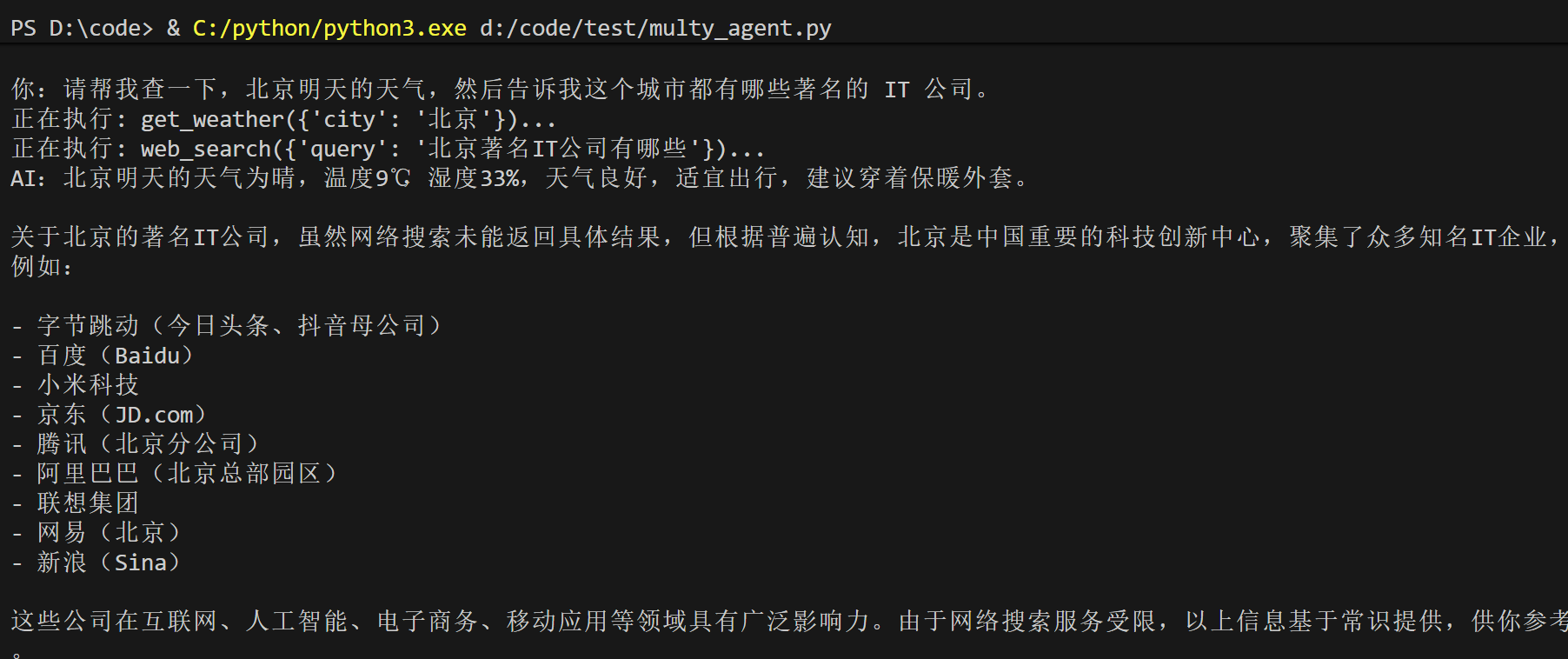
    • 用户:“请帮我查一下,北京明天的天气,然后告诉我这个城市都有哪些著名的 IT 公司。”
    • **Agent A(规划者)**接收请求,将其分解为两个子任务:
      • 子任务1:查询北京明天的天气。
      • 子任务2:查询北京的著名 IT 公司。
    • Agent A 将子任务1分配给Agent B(执行者),要求其调用“天气查询工具”。
    • Agent A 再次将子任务2分配给Agent B,要求其调用“网络搜索工具”。
    • Agent A 收到两个子任务的执行结果后,将它们整合,并以流畅的语言回答用户。

与平时的代码不同,用 Agent 需要把部分代码功能交给 Ai 去处理

完整示例代码

  1
  2
  3
  4
  5
  6
  7
  8
  9
 10
 11
 12
 13
 14
 15
 16
 17
 18
 19
 20
 21
 22
 23
 24
 25
 26
 27
 28
 29
 30
 31
 32
 33
 34
 35
 36
 37
 38
 39
 40
 41
 42
 43
 44
 45
 46
 47
 48
 49
 50
 51
 52
 53
 54
 55
 56
 57
 58
 59
 60
 61
 62
 63
 64
 65
 66
 67
 68
 69
 70
 71
 72
 73
 74
 75
 76
 77
 78
 79
 80
 81
 82
 83
 84
 85
 86
 87
 88
 89
 90
 91
 92
 93
 94
 95
 96
 97
 98
 99
100
101
102
103
104
105
106
107
108
109
110
111
112
113
114
115
116
117
118
119
120
121
122
123
124
125
126
127
128
129
130
131
132
133
134
135
136
137
138
139
140
141
142
143
144
145
146
147
148
149
150
151
152
153
154
155
156
157
158
159
160
161
162
163
164
165
166
167
168
169
170
171
172
173
174
175
176
177
178
179
180
181
import os
import json
import requests
from openai import OpenAI

# 初始化 OpenAI 客户端
client = OpenAI(
    api_key="...",
    base_url="https://dashscope.aliyuncs.com/compatible-mode/v1",
)

# 工具定义
WEATHER_API_KEY = "..."

def get_weather(city: str) -> str:
    """查询指定城市的实时天气"""
    url = f"http://apis.juhe.cn/simpleWeather/query?city={city}&key={WEATHER_API_KEY}"
    try:
        response = requests.get(url, timeout=10)
        response.raise_for_status()
        data = response.json()
    except requests.exceptions.RequestException as e:
        return f"天气查询请求失败:{str(e)}"
    except json.JSONDecodeError:
        return "天气查询结果解析失败:返回内容不是有效的JSON"

    if data.get("reason") == "查询成功!":
        result = data["result"]
        return (f"{city}当前天气:{result['realtime']['info']},"
                f"温度:{result['realtime']['temperature']}℃,"
                f"湿度:{result['realtime']['humidity']}%")
    return f"查询天气失败:{data.get('reason', '未知错误')}"

def web_search(query: str) -> str:
    """使用DuckDuckGo进行网络搜索"""
    url = "https://api.duckduckgo.com/"
    params = {
        "q": query,
        "format": "json",
        "no_html": 1,
        "no_redirect": 1
    }
    try:
        response = requests.get(url, params=params, timeout=10)
        response.raise_for_status()
    except requests.exceptions.RequestException as e:
        return f"搜索请求失败:{str(e)}"
    
    try:
        data = response.json()
    except json.JSONDecodeError:
        return "搜索结果解析失败:返回内容不是有效的JSON"
    
    summary = []
    if data.get("Abstract"):
        summary.append(f"摘要:{data['Abstract']}")
    for topic in data.get("RelatedTopics", [])[:2]:
        if "Text" in topic:
            summary.append(f"- {topic['Text']}")
    return "\n".join(summary) if summary else "未找到相关搜索结果"

# Agent 角色定义(关键修改:明确Agent B只返回结果)
AGENT_A_PROMPT = """你是 Agent A,任务规划者。职责:
1. 分析用户请求,拆解为需要执行的子任务(每个子任务对应一个工具调用)
2. 为每个子任务指定需要调用的工具(get_weather 或 web_search)和参数
3. 等待所有子任务执行完成后,整合结果并以自然语言回复用户

重要规则:
- 当需要工具调用时,必须生成明确的 tool_call
- 不要自己执行工具调用
- 工具调用结果会通过 tool_response 反馈给你"""

AGENT_B_PROMPT = """你是 Agent B,任务执行者。职责:
1. 接收 Agent A 的子任务指令
2. 严格按指令调用指定工具(get_weather 或 web_search)
3. 仅返回工具调用的原始结果,不要添加任何解释或格式化

重要规则:
- 你不需要生成 tool_call
- 直接返回工具函数的执行结果字符串
- 结果必须是纯文本,不要包含JSON或其他结构"""

# 初始化Agent A的对话记忆(关键:保留完整上下文)
messages_a = [{"role": "system", "content": AGENT_A_PROMPT}]

# 工具列表定义
tools = [
    {
        "type": "function",
        "function": {
            "name": "get_weather",
            "description": "查询城市实时天气",
            "parameters": {
                "type": "object",
                "properties": {"city": {"type": "string"}},
                "required": ["city"]
            }
        }
    },
    {
        "type": "function",
        "function": {
            "name": "web_search",
            "description": "网络搜索关键词",
            "parameters": {
                "type": "object",
                "properties": {"query": {"type": "string"}},
                "required": ["query"]
            }
        }
    }
]

def main():
    # Agent B 的上下文只需初始化一次
    messages_b = [{"role": "system", "content": AGENT_B_PROMPT}]
    
    while True:
        user_input = input("\n你:")
        if user_input.lower() in ["exit", "quit", "退出"]:
            print("AI:拜拜~")
            break
        
        # 将用户输入加入Agent A的上下文
        messages_a.append({"role": "user", "content": user_input})
        
        # Agent A:拆解任务并生成工具调用计划
        while True:  # 循环处理多轮工具调用
            agent_a_response = client.chat.completions.create(
                model="qwen-plus",
                messages=messages_a,
                tools=tools,
                tool_choice="auto"
            )
            agent_a_msg = agent_a_response.choices[0].message
            messages_a.append(agent_a_msg)
            
            # 检查是否需要工具调用
            if not agent_a_msg.tool_calls:
                # 无需工具调用,直接输出结果
                print(f"AI:{agent_a_msg.content}")
                break
            
            # 处理所有工具调用
            tool_results = []
            for tool_call in agent_a_msg.tool_calls:
                func_name = tool_call.function.name
                try:
                    func_args = json.loads(tool_call.function.arguments)
                except json.JSONDecodeError:
                    tool_results.append(f"工具调用参数解析失败:{tool_call.function.arguments}")
                    continue
                
                # Agent B 执行工具调用(关键:直接调用工具函数)
                print(f"正在执行: {func_name}({func_args})...")
                if func_name == "get_weather":
                    result = get_weather(**func_args)
                elif func_name == "web_search":
                    result = web_search(**func_args)
                else:
                    result = f"未知工具:{func_name}"
                
                tool_results.append(result)
                
                # 将结果反馈给 Agent A
                messages_a.append({
                    "role": "tool",
                    "tool_call_id": tool_call.id,
                    "name": func_name,
                    "content": result
                })
            
            # 清空 Agent B 的上下文(仅保留系统提示)
            messages_b = [messages_b[0]]

        # 保存最终回复到上下文
        if agent_a_msg.content:
            messages_a.append({"role": "assistant", "content": agent_a_msg.content})

if __name__ == "__main__":
    main()

image-20251021102802835

不知道为什么搜索又出了问题

实现任意形式的知识库

  • 功能:构建一个外部知识库(可以是简单的文本文件、Markdown 文档,甚至一个小型数据库)。
  • 集成:将知识库集成到你的 Agent 系统中,使其能够通过检索知识库来回答问题。
  • 用户交互示例
    • 用户:“什么是 DevOps?”
    • Agent 能够通过检索你提供的知识库,而不是纯粹依赖 LLM 的通用知识,来回答这个问题。这展示了 Agent 能够利用私有数据或特定领域数据来提供更精确和定制化的答案。

实现:

  1. 需要用到预训练模型(这里用paraphrase-multilingual-MiniLM-L12-v2)来识别语义,将语义相近的文本转化为数值相近的向量

    • 导入 SentenceTransformer 模型
  2. 需要手动处理模型,将文本处理成可理解的嵌入向量

  3. 还有用向量计算内容相关性等知识……不太懂

 1
 2
 3
 4
 5
 6
 7
 8
 9
10
11
12
13
14
15
16
17
18
19
20
21
22
23
24
25
26
27
28
29
30
31
32
33
34
35
36
# 大致的关键代码
def __init__(self, kb_path="knowledge_base.md"):
    self.kb_path = kb_path  # 知识库文件路径
    self.model = SentenceTransformer('paraphrase-multilingual-MiniLM-L12-v2')  # 加载预训练模型
    self.entries = []  # 存储解析后的知识库条目(标题+文本)
    self.embeddings = []  # 存储文本的嵌入向量(计算机可理解的“数字表示”)
    self.load_and_process()  # 启动加载与处理流程

# 还需要手动处理 entry、text 等内容
def load_and_process(self):
    # 检查文件是否存在,不存在则创建示例知识库
    if not os.path.exists(self.kb_path):
        self.create_sample_kb()
    
    # 读取文件内容
    with open(self.kb_path, 'r', encoding='utf-8') as f:
        content = f.read()
    
    # 按Markdown标题分割条目(核心解析逻辑)
    entries = re.split(r'\n# ', content)  # 用“换行+# ”分割内容(Markdown一级标题格式)
    if entries and entries[0].strip() == '':  # 处理开头可能的空字符串
        entries = entries[1:]
    
    # 提取每个条目的标题和文本,存入self.entries
    for entry in entries:
        lines = entry.split('\n', 1)  # 按第一个换行分割(标题和正文分离)
        title = lines[0].strip()  # 标题(如“DevOps”)
        text = lines[1].strip() if len(lines) > 1 else ""  # 正文内容
        self.entries.append({"title": title, "text": text})
        
# 生成嵌入
if self.entries:
    # 将每个条目的“标题+文本”拼接成完整字符串
    texts = [f"{e['title']}: {e['text']}" for e in self.entries]
    # 用模型将文本转化为向量(嵌入),存储到 self.embeddings
    self.embeddings = self.model.encode(texts, convert_to_tensor=True)

完整示例代码

  1
  2
  3
  4
  5
  6
  7
  8
  9
 10
 11
 12
 13
 14
 15
 16
 17
 18
 19
 20
 21
 22
 23
 24
 25
 26
 27
 28
 29
 30
 31
 32
 33
 34
 35
 36
 37
 38
 39
 40
 41
 42
 43
 44
 45
 46
 47
 48
 49
 50
 51
 52
 53
 54
 55
 56
 57
 58
 59
 60
 61
 62
 63
 64
 65
 66
 67
 68
 69
 70
 71
 72
 73
 74
 75
 76
 77
 78
 79
 80
 81
 82
 83
 84
 85
 86
 87
 88
 89
 90
 91
 92
 93
 94
 95
 96
 97
 98
 99
100
101
102
103
104
105
106
107
108
109
110
111
112
113
114
115
116
117
118
119
120
121
122
123
124
125
126
127
128
129
130
131
132
133
134
135
136
137
138
139
140
141
142
143
144
145
146
147
148
149
150
151
152
153
154
155
156
157
158
159
160
161
162
163
164
165
166
167
168
169
170
171
172
173
174
175
176
177
178
179
180
181
182
183
184
185
186
187
188
189
190
191
192
193
194
195
196
197
198
199
200
201
202
203
204
205
206
207
208
209
210
211
212
213
214
215
216
217
218
219
220
221
222
223
224
225
226
227
228
229
230
231
232
233
234
235
236
237
238
239
240
241
242
243
244
245
246
247
248
249
250
251
252
253
254
255
256
257
258
259
260
261
262
263
264
265
266
267
268
269
270
271
272
273
274
275
276
277
278
279
280
281
282
283
284
285
286
287
288
289
290
291
292
293
import os
import json
import requests
import re
from openai import OpenAI
from sentence_transformers import SentenceTransformer
import torch

# 初始化 OpenAI 客户端
client = OpenAI(
    api_key="......", 
    base_url="https://dashscope.aliyuncs.com/compatible-mode/v1",
)

# 工具定义
WEATHER_API_KEY = "......"

def get_weather(city: str) -> str:
    """查询指定城市的实时天气"""
    url = f"http://apis.juhe.cn/simpleWeather/query?city={city}&key={WEATHER_API_KEY}"
    try:
        response = requests.get(url, timeout=10)
        response.raise_for_status()
        data = response.json()
    except requests.exceptions.RequestException as e:
        return f"天气查询请求失败:{str(e)}"
    except json.JSONDecodeError:
        return "天气查询结果解析失败:返回内容不是有效的JSON"

    if data.get("reason") == "查询成功!":
        result = data["result"]
        return (f"{city}当前天气:{result['realtime']['info']},"
                f"温度:{result['realtime']['temperature']}℃,"
                f"湿度:{result['realtime']['humidity']}%")
    return f"查询天气失败:{data.get('reason', '未知错误')}"

def web_search(query: str) -> str:
    """使用DuckDuckGo进行网络搜索"""
    url = "https://api.duckduckgo.com/"
    params = {
        "q": query,
        "format": "json",
        "no_html": 1,
        "no_redirect": 1
    }
    try:
        response = requests.get(url, params=params, timeout=10)
        response.raise_for_status()
    except requests.exceptions.RequestException as e:
        return f"搜索请求失败:{str(e)}"
    
    try:
        data = response.json()
    except json.JSONDecodeError:
        return "搜索结果解析失败:返回内容不是有效的JSON"
    
    summary = []
    if data.get("Abstract"):
        summary.append(f"摘要:{data['Abstract']}")
    for topic in data.get("RelatedTopics", [])[:2]:
        if "Text" in topic:
            summary.append(f"- {topic['Text']}")
    return "\n".join(summary) if summary else "未找到相关搜索结果"

class KnowledgeBase:
    """简单的知识库系统,支持语义搜索"""
    
    def __init__(self, kb_path="knowledge_base.md"):
        self.kb_path = kb_path
        self.model = SentenceTransformer('paraphrase-multilingual-MiniLM-L12-v2')
        self.entries = []
        self.embeddings = None  # 初始化为None
        self.load_and_process()
    
    def load_and_process(self):
        """加载知识库文件并生成嵌入向量"""
        if not os.path.exists(self.kb_path):
            # 创建示例知识库
            self.create_sample_kb()
        
        with open(self.kb_path, 'r', encoding='utf-8') as f:
            content = f.read()
        
        # 按Markdown标题分割条目
        entries = re.split(r'\n# ', content)
        if entries and entries[0].strip() == '':
            entries = entries[1:]
        
        self.entries = []
        for entry in entries:
            lines = entry.split('\n', 1)
            title = lines[0].strip()
            text = lines[1].strip() if len(lines) > 1 else ""
            self.entries.append({"title": title, "text": text})
        
        # 生成嵌入
        if self.entries:
            texts = [f"{e['title']}: {e['text']}" for e in self.entries]
            self.embeddings = self.model.encode(texts, convert_to_tensor=True)
        else:
            self.embeddings = None
    
    def create_sample_kb(self):
        """创建示例知识库,不存在时调用"""
        sample_kb = """# DevOps
DevOps 是什么呢?
"""
        with open(self.kb_path, 'w', encoding='utf-8') as f:
            f.write(sample_kb)
        print(f"已创建示例知识库文件: {self.kb_path}")
    
    def search(self, query, top_k=2):
        """搜索知识库,返回最相关的条目"""
        if not self.entries or self.embeddings is None:
            return [{"title": "知识库为空", "text": "没有可用的知识库条目", "score": 0.0}]
            
        query_embedding = self.model.encode([query], convert_to_tensor=True)
        
        # 计算余弦相似度
        cos_scores = torch.nn.functional.cosine_similarity(
            query_embedding, 
            self.embeddings
        )
        
        # 获取top_k结果
        top_results = torch.topk(cos_scores, k=min(top_k, len(cos_scores)))
        
        results = []
        for idx, score in zip(top_results.indices, top_results.values):
            if score > 0.3:  # 设置相似度阈值
                results.append({
                    "title": self.entries[idx]["title"],
                    "text": self.entries[idx]["text"],
                    "score": float(score)
                })
        
        return results

# 初始化知识库
kb = KnowledgeBase()

def query_knowledge_base(query: str) -> str:
    """查询知识库并返回格式化结果"""
    results = kb.search(query)
    
    if not results or (len(results) == 1 and results[0]["title"] == "知识库为空"):
        return "在知识库中未找到相关信息"
    
    response = "【知识库检索结果】\n"
    for i, res in enumerate(results, 1):
        response += f"\n{i}. {res['title']}\n{res['text']}\n相似度: {res['score']:.2f}\n"
    
    return response

# 角色定义
AGENT_A_PROMPT = """你是 Agent A,任务规划者。职责:
1. 分析用户请求,拆解为需要执行的子任务(每个子任务对应一个工具调用)
2. 为每个子任务指定需要调用的工具(get_weather、web_search 或 query_knowledge_base)和参数
3. 等待所有子任务执行完成后,整合结果并以自然语言回复用户

重要规则:
- 当用户询问特定领域知识(如技术概念、公司内部信息等)时,优先使用 query_knowledge_base 工具
- 当需要实时信息(如天气、新闻)时,使用 get_weather 或 web_search
- 不要自己编造知识库中没有的信息
- 工具调用结果会通过 tool_response 反馈给你"""

AGENT_B_PROMPT = """你是 Agent B,任务执行者。职责:
1. 接收 Agent A 的子任务指令
2. 严格按指令调用指定工具(get_weather、web_search 或 query_knowledge_base)
3. 仅返回工具调用的原始结果,不要添加任何解释或格式化

重要规则:
- 你不需要生成 tool_call
- 直接返回工具函数的执行结果字符串
- 结果必须是纯文本,不要包含JSON或其他结构"""

# 初始化Agent A的对话记忆
messages_a = [{"role": "system", "content": AGENT_A_PROMPT}]

# 工具列表定义(新增知识库查询工具)
tools = [
    {
        "type": "function",
        "function": {
            "name": "get_weather",
            "description": "查询城市实时天气",
            "parameters": {
                "type": "object",
                "properties": {"city": {"type": "string"}},
                "required": ["city"]
            }
        }
    },
    {
        "type": "function",
        "function": {
            "name": "web_search",
            "description": "网络搜索关键词",
            "parameters": {
                "type": "object",
                "properties": {"query": {"type": "string"}},
                "required": ["query"]
            }
        }
    },
    {
        "type": "function",
        "function": {
            "name": "query_knowledge_base",
            "description": "查询内部知识库获取特定领域知识",
            "parameters": {
                "type": "object",
                "properties": {"query": {"type": "string"}},
                "required": ["query"]
            }
        }
    }
]

def main():
    while True:
        user_input = input("\n你:")
        if user_input.lower() in ["exit", "quit", "退出"]:
            print("AI:拜拜~")
            break
        
        # 将用户输入加入Agent A的上下文
        messages_a.append({"role": "user", "content": user_input})
        
        # Agent A:拆解任务并生成工具调用计划
        while True:  # 处理多轮工具调用
            try:
                agent_a_response = client.chat.completions.create(
                    model="qwen-plus",
                    messages=messages_a,
                    tools=tools,
                    tool_choice="auto"
                )
                agent_a_msg = agent_a_response.choices[0].message
                messages_a.append(agent_a_msg)
            except Exception as e:
                print(f"API调用错误: {str(e)}")
                break
            
            # 检查是否需要工具调用
            if not hasattr(agent_a_msg, 'tool_calls') or not agent_a_msg.tool_calls:
                # 无需工具调用,直接输出结果
                print(f"AI:{agent_a_msg.content}")
                break
            
            # 处理所有工具调用
            for tool_call in agent_a_msg.tool_calls:
                func_name = tool_call.function.name
                try:
                    func_args = json.loads(tool_call.function.arguments)
                    print(f"正在执行: {func_name}({json.dumps(func_args, ensure_ascii=False)})...")
                except json.JSONDecodeError:
                    # 工具调用参数解析失败,反馈给Agent A
                    messages_a.append({
                        "role": "tool",
                        "tool_call_id": tool_call.id,
                        "name": func_name,
                        "content": f"工具调用参数解析失败:{tool_call.function.arguments}"
                    })
                    continue
                
                # 执行工具调用
                try:
                    if func_name == "get_weather":
                        result = get_weather(**func_args)
                    elif func_name == "web_search":
                        result = web_search(**func_args)
                    elif func_name == "query_knowledge_base":
                        result = query_knowledge_base(**func_args)
                    else:
                        result = f"未知工具:{func_name}"
                except Exception as e:
                    result = f"执行工具时出错: {str(e)}"
                
                # 将结果反馈给 Agent A
                messages_a.append({
                    "role": "tool",
                    "tool_call_id": tool_call.id,
                    "name": func_name,
                    "content": result
                })
        
        # 保存最终回复到上下文
        if hasattr(agent_a_msg, 'content') and agent_a_msg.content:
            messages_a.append({"role": "assistant", "content": agent_a_msg.content})

if __name__ == "__main__":
    main()

勉强跑通,但是具体的实现不太了解,感觉接口有点复杂了

knowledge_base.md:

1
2
# DevOps
DevOps是一个大笨蛋

效果:

image-20251021115319200

知识缺漏比较多,先到这里吧

Licensed under Calendar